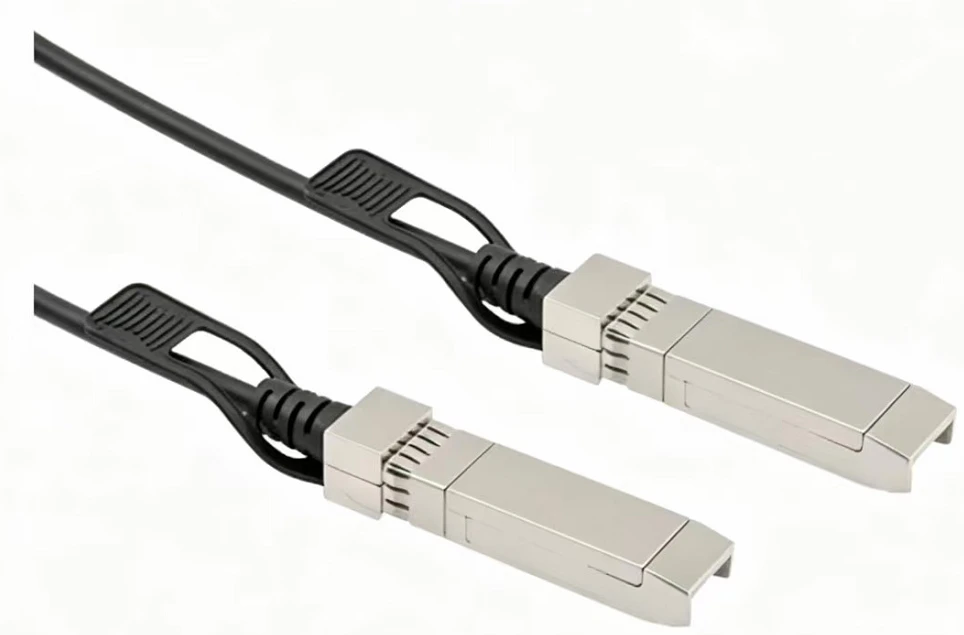
The short-distance high-speed networking in data centers is becoming increasingly prevalent, and DAC (Direct Attach Cable) is the core cabling solution for interconnection within cabinets and between adjacent cabinets. With its minimal passive design and superior cost-performance ratio, DAC is widely used in high-speed link deployments. This article will detail the product features and practical application advantages of DAC.
1. Core characteristics of DAC direct-connect copper cable
DAC direct-connect copper cables are the mainstream short-distance high-speed interconnect cables in data centers, with the full name being direct-connect copper cable assemblies. Both ends are prefabricated with standard optical module interfaces such as QSFP and SFP, designed as an integrated finished product, eliminating the need for on-site termination or splicing. The main body of the cable is made of copper conductor material, featuring good tensile and bending resistance, suitable for complex routing within cabinets. The product primarily adopts a passive design, requiring no external power supply during operation, ensuring stable electrical transmission and basic electromagnetic interference resistance. The effective transmission distance of conventional models is mainly concentrated between 1 and 10 meters, positioning them for ultra-short-distance link scenarios. The outer sheath of the cable often adopts a flame-retardant material, complying with fire prevention regulations for computer room wiring. The overall structure is simple, with fewer components, resulting in a lower failure rate over long-term use.
2. Application Advantages of DAC Direct-Connect Copper Cable
In scenarios such as data centers and server rooms, the practical advantages of DAC (Direct Attach Cables) are quite significant. Firstly, the cost advantage is prominent. The raw material and processing costs of copper are much lower than those of fiber optic products, which can effectively control the project procurement budget. Secondly, the deployment efficiency is extremely high. The integrated finished product supports plug-and-play, eliminating traditional cable termination, testing, and other processes, significantly shortening the construction period and reducing line failures caused by human operations. At the same time, the passive design achieves zero additional power consumption, which does not increase the heat dissipation and power supply load of the room, and adapts to the energy-saving requirements of high-density cabinets. In addition, the cables are resistant to wear and tear, and are very convenient for daily operation and maintenance, plugging, and adjusting the wiring. It is a cost-effective solution for short-distance high-speed interconnection within cabinets and between adjacent cabinets.
3. Brief Comparison between DAC and AOC Active Optical Cables
DAC and AOC (Active Optical Cable) share the same interface form and are both used for high-speed link interconnection, but their applicable scenarios differ significantly. In terms of transmission distance, DAC is generally only suitable for ultra-short distances within 10 meters, while AOC, relying on the characteristics of optical fibers, can achieve transmission distances up to hundreds of meters, covering a wider range. In terms of cost, DAC has a significant price advantage, being much cheaper than AOC of the same specification. In terms of power consumption, AOC is an active device that consumes power continuously during operation, while passive DAC has no power consumption, making it more conducive to energy conservation in computer rooms. In terms of cabling experience, DAC cables are thicker and have a larger bending radius, while AOC fiber optic cables are thin and flexible, allowing for more flexible routing. In terms of anti-interference capability, AOC performs better and is preferred in strong electromagnetic environments; in short-distance scenarios in ordinary computer rooms, DAC's comprehensive practicality and cost-effectiveness prevail.