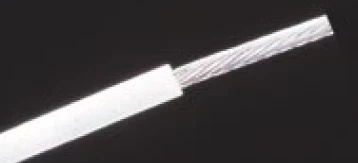
Tinning is primarily performed to assure that the wire to be soldered has a uniform and readily solderable surface. Tinning
of stranded wire has the added benefit of bonding the individual wire strands together, thereby allowing the wire to be formed
to terminals or attachment points without separation of the individual strands.
Note: Wires intended to be secured in threaded fasteners or crimp terminations shall never be tinned.
For Classes 2 and 3:
• Portions of wire that will be soldered shall be tinned prior to mounting.
• The solder shall wet the tinned portion of the wire and penetrate to the inner strands of stranded wire.
• Limited solder wicking during soldering of wire is permissible as long as the solder does not extend to a portion of the wire that
is required to remain flexible.
The tinning should leave a smooth coating of solder, and the outline of the strands should be visible.
Acceptable - Class 1,2,3
• Wire is uniformly coated with a smooth solder coat.
• Stranded wire is uniformly coated with a thin coat of solder
with the individual strands of the wire easily visible.
• Untinned length of strands from end of insulation is not
greater than one wire diameter (D).
Process Indicator - Class 2,3
• Strands not discernible but does not interfere with form, fit,
function or reliability.
Defect - Class 2,3
• Stranded wire not tinned prior to assembly.
Defect - Class 1,2,3
• Wire has pinholes, voids or areas where solder has not wetted
to the wire.
Defect - Class 3
• Length of untinned strands from end of insulation is greater
than one wire diameter (D).