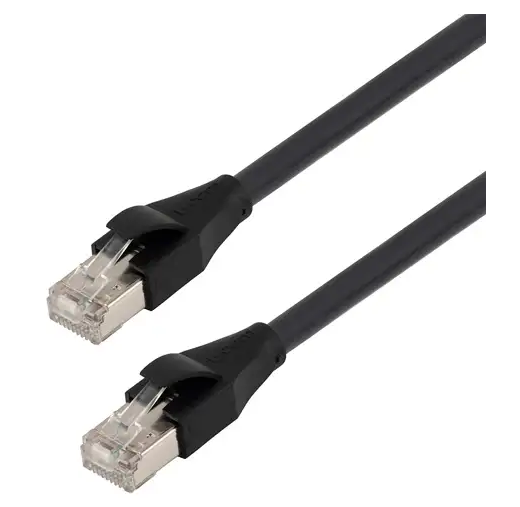
Shielded Twisted Pair (STP) is a type of Ethernet cable that adds a shielding layer outside of twisted pair cables to reduce electromagnetic interference (EMI) and radio frequency interference (RFI). Shielded Ethernet cables are very useful in certain specific situations, and this article will provide a detailed analysis of their use.
1, High electromagnetic interference environment
Industrial environment: There are a large number of electric motors, generators, and other electrical equipment in factories, production workshops, and other environments, which can generate strong electromagnetic interference.
Data center: There are a large number of servers, switches, and other electronic devices inside the data center that generate electromagnetic interference during operation.
Medical equipment: Medical equipment in hospitals is very sensitive to electromagnetic interference and requires the use of shielded network cables to ensure the stability and reliability of data transmission.
The shielding layer can effectively absorb and reflect external electromagnetic interference, protecting internal signal transmission from being affected. In high electromagnetic interference environments, unshielded network cables may be affected by interference, leading to data transmission errors or interruptions, while shielded network cables can provide higher stability.
2, Long distance transmission
Long distance cabling: When long-distance data transmission is required, such as connecting large parks or buildings.
High speed network: In applications that require high-speed data transmission, such as Gigabit Ethernet and 10 Gigabit Ethernet.
The shielding layer can reduce signal attenuation during long-distance transmission, improve signal integrity and transmission quality. In high-speed networks, shielded network cables can provide better anti-interference performance, ensuring high data transmission rates and low error rates.
3, An environment with high safety requirements
Government agencies: places where government agencies, military facilities, and other entities have strict requirements for cybersecurity.
Financial institutions: Banks, stock exchanges, and other financial industries have extremely high requirements for data security and integrity.
Research institutions: Laboratories, research institutions, etc. have strict requirements for the accuracy and security of data transmission.
The shielding layer can prevent external devices from stealing transmitted data through electromagnetic radiation, improving data security. In highly confidential environments, shielded network cables can provide additional physical protection to prevent data leakage.
4, High frequency signal transmission
Audio/Video Transmission: Applications that require high-quality signal transmission, such as high-definition video transmission and professional audio systems.
Precision instruments: scientific instruments, measuring equipment, and other applications that have strict requirements for signal quality.
The shielding layer can effectively reduce noise during high-frequency signal transmission, improve signal clarity and quality. In high-frequency signal transmission, shielded network cables can provide higher signal-to-noise ratio, ensuring the accuracy and stability of the signal.
5, Special environment
Outdoor cabling: In outdoor environments, such as outdoor monitoring systems, wireless base stations, etc.
Extreme temperature: in high or low temperature environments, such as industrial ovens, freezers, etc.
Shielded network cables typically have better weather resistance and can maintain good performance in harsh environmental conditions. The shielding layer can provide additional protection, prevent corrosion and oxidation, and extend the service life of the network cable.
6, Coexistence of multiple systems
Integrated cabling system: Multiple types of signal transmission exist simultaneously in the same cabling system, such as power lines, telephone lines, data lines, etc.
Mixed signal environment: In an environment where both analog and digital signals need to be transmitted simultaneously.
The shielding layer can effectively isolate the mutual interference between different signals, ensuring the independence and stability of each signal. In an environment where multiple systems coexist, shielded Ethernet cables can provide better compatibility and interoperability.
7, Standard and regulatory requirements
Compliant with standards: Some industry standards or specifications explicitly require the use of shielded network cables, such as the TIA/EIA-568-B standard.
Certification requirements: Certain projects or applications require specific certifications, such as EMC (Electromagnetic Compatibility) certification.
Using shielded network cables can ensure compliance with relevant industry standards and specifications, and meet certification requirements. Adhering to standards and regulations can avoid risks and problems caused by non-compliance with requirements.