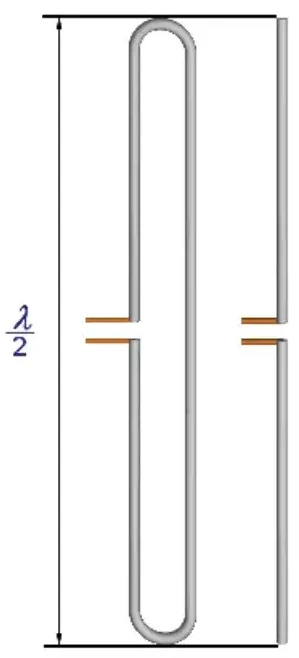
Half wave antenna is a common type of antenna. This article will briefly describe the structure and principle of half wave antenna, and take a look at the special features of this type of antenna.
A half wave antenna (dipole, Hertz) consists of two lengths of poles or tubes, each length being 1/4 wavelength of a specific frequency. It is the basic unit that constitutes many complex antennas. For dipoles, the current is maximum at the center and minimum at both ends. The center voltage is the smallest, and the voltage at both ends is the largest.
It is also possible to supply energy to the half wave antenna by dividing the antenna at its center and connecting the transmission line from the final transmitter output stage to both ends of the half wave antenna. Due to the fact that the antenna is fed at the center (a point of low voltage and high current), this type of feeding method is called center feeding or current feeding method. The feeding point is important for determining the type of transmission line to be used.
The standing waves of current and voltage are similar to those generated by parallel oscillation circuits. However, compared to the gain of an isotropic radiator, which is exactly 1, the gain of a half wave antenna has reached around 1.5, and the maximum radiation comes from the direction perpendicular to the antenna axis.
A half wave dipole is also generated by a simple oscillating circuit. We simply assume that the capacitor plates of the oscillating circuit are separated and slightly bent. The capacitance has decreased, but the capacitor is still a capacitor. As the capacitor plates are further separated, the electric field lines must cover an increasingly larger area. When the shape of the capacitor can no longer be recognized, electric field lines pass through free space, forming a half wave dipole that is feeding at the center.