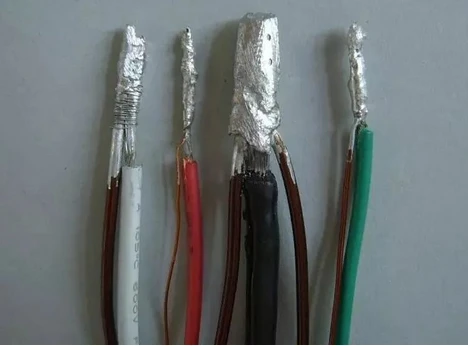
Some electrical installation workers often do not pay attention to the installation quality when laying wires, and do not install insulation sleeves where they should be used; There is no junction box installed in the place where a junction box should be used; Even at the wire joints, instead of using the twisting method, an illegal hook shaped connection method is used. This hook shaped connection method has a high contact resistance and constantly heats up when powered on, causing nearby wooden boards to gradually dry and carbonize, eventually leading to combustion and causing a fire.
Installation precautions
1. The connection of conductors requires low resistance and sufficient mechanical strength, and there should be no sharp corners at the connection.
The commonly used method for connecting conductors in medium and low voltage cables is crimping, which should pay attention to:
(1) Choose a conductor connecting tube with appropriate conductivity and mechanical strength;
(2) The clearance between the inner diameter of the pressure tube and the outer diameter of the connected wire core should be set at 0.8~1.4mm;
(3) The resistance value of the crimped joint should not be greater than 1.2 times that of the conductor of equal cross-section, and the tensile strength of the copper conductor joint should not be less than 60N/㎡;
(4) Before crimping, apply conductive adhesive to the outer surface of the conductor and the inner surface of the connecting pipe, and use a wire brush to damage the oxide film;
(5) Sharp corners, burrs, etc. on connecting pipes, wire core conductors, etc. should be smoothed with a file or sandpaper.
2. Internal semiconductor shielding treatment
If the cable body has an internal shielding layer, the internal shielding layer of the crimping tube conductor part must be restored when making the joint. A portion of the internal semiconductor shielding of the cable must be left to allow the internal shielding of the connection head on the connecting tube to be interconnected, ensuring the continuity of the internal semiconductor and evenly distributing the field strength at the joint connection.
3. Treatment of external semiconductor shielding
External semiconductor shielding is a semiconducting material that provides a uniform electric field outside the insulation of cables and cable joints. Like internal semiconductor shielding, it plays a very important role in cables and joints. The outer semiconductor port must be neat and uniform, and it is required to have a smooth transition with insulation. Semiconductor tape should be added to the cable joint to connect with the outer semiconductor shielding of the cable body.
4. Treatment of cable reaction force cone
A reaction force cone with accurate shape and size during construction has an equal potential distribution on the entire cone surface. When making a cross-linked cable reaction cone, specialized cutting tools are generally used, or it can be slightly heated with a low flame and cut with a fast knife. After the basic shape is formed, it is scraped with 2mm thick glass and finally polished with sandpaper from coarse to fine until smooth.
5. Metal shielding and grounding treatment
Metal shielding is mainly used in cables and joints to conduct cable fault short-circuit currents, as well as to shield electromagnetic interference from nearby communication equipment. In operation, the metal shielding is at zero potential in a well grounded state. When a cable fault occurs, it has the ability to conduct short-circuit currents in a very short period of time. The grounding wire should be reliably welded, and the metal shielding and armor tape on both ends of the cable body should be firmly welded. The grounding of the terminal should be reliable.
6. Sealing and mechanical protection of joints
The sealing and mechanical protection of the joint are the guarantees for ensuring the safe and reliable operation of the joint. Moisture and moisture should be prevented from seeping into the cable joints, and joint protection grooves or cement protection boxes should be built or installed at the joint positions.