


Crosslinking - converting linear polyethylene molecules into a three-dimensional network structure through physical or chemical methods, thereby improving their mechanical and thermal properties. There are two main types of cross-linked insulation: physical cross-linking and chemical cross-linking.
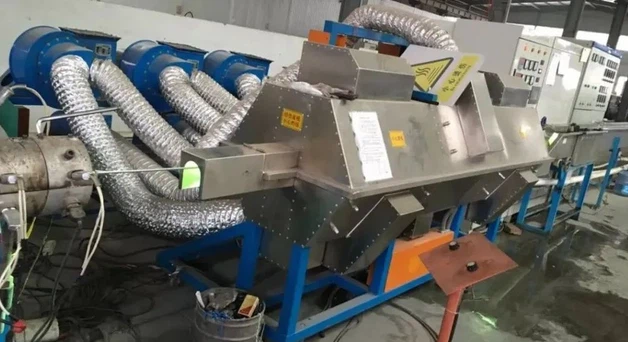
Physical crosslinking, also known as irradiation crosslinking, is generally suitable for low-voltage cables with thin insulation thickness.
Chemical cross-linking is mainly divided into two types: peroxide cross-linking and silane grafting cross-linking. Among them, peroxide cross-linking is used for insulation of medium voltage and (ultra) high voltage cables, while silane grafting cross-linking is generally used for conventional low voltage cross-linked cables.
The irradiation cross-linking process is mainly suitable for the manufacturing of special low-voltage cross-linked cables, such as nuclear grade cables, high operating temperature cables (long-term operating temperature can reach 150 ℃), cross-linked low smoke halogen-free flame-retardant wires and cables, etc. Due to the influence of material technology and y-ray radiation penetration, the irradiation cross-linking process is not suitable for the manufacturing of medium voltage and (ultra) high voltage cables.
UV crosslinking technology is another new crosslinking technology developed after chemical crosslinking and irradiation crosslinking. It is a technological innovation achievement independently developed and has independent intellectual property rights in China. The principle of ultraviolet crosslinking is to use polyolefin as the main raw material and add an appropriate amount of photoinitiator. By irradiating with ultraviolet light, the photoinitiator absorbs specific wavelengths of ultraviolet light to generate polyolefin free radicals, which then undergo a series of rapid polymerization reactions to produce crosslinked polyolefins with a three-dimensional network structure. This has opened up a new path for the production of crosslinked cables and has been put into the manufacturing of low-voltage crosslinked cables. The following mainly introduces chemical crosslinking.
1, Peroxide crosslinking
The peroxide crosslinking method is a method of inducing crosslinking by adding crosslinking agents. It is mainly suitable for the manufacturing of cross-linked polyethylene insulated power cables with rated voltage levels of 10kV and above and various cross-sectional areas.
(1) Steam crosslinking (SCP)
Steam crosslinking manufacturing technology is the oldest crosslinking method that evolved from rubber continuous vulcanization technology. This method uses steam at a certain pressure and temperature as the heating and pressurization medium to crosslink polyethylene. Steam crosslinking was successfully researched by GE in 1957, and Sumitomo Electric Company in Japan introduced this technology in 1959 and put into production in 1960.
In the early stage, saturated steam was used as the medium, and the pressure and temperature inside the cross-linking tube were directly related. To increase the steam temperature, it was necessary to increase the steam pressure at the same time. For every 10 ℃ increase in temperature, the pressure would increase by about 5kg, making it difficult to achieve sufficient high temperature and high energy consumption; Later, it was developed to increase steam temperature by heating the cross-linked pipe wall (known as superheated steam, which does not require increasing pressure to increase temperature), mainly used in rubber vulcanization units. Due to the direct contact between water vapor and molten polyethylene inside the cross-linked tube, moisture will permeate and diffuse into the insulation. During the cooling process of the cable, the water vapor inside the insulation reaches saturation and forms micropores, which can trigger branch discharge after being put into operation. This is the fatal weakness of this method. So, starting from the 1960s, some new dry crosslinking processes emerged.
(2) Infrared crosslinking method (RCP) and dry crosslinking
Infrared crosslinking method, also known as thermal radiation crosslinking method (RCP), is a dry crosslinking process invented by Sumitomo Electric Company in Japan in 1967.
The method of crosslinking polymers with infrared radiation was patented as early as 1937 by General Electric (GE) in France for the vulcanization of rubber products. In 1961, W.R. Grace of the United States obtained a patent for manufacturing polyethylene film using infrared irradiation method. Sumitomo Electric Company in Japan was inspired by the above two patents and applied for a patent in June 1966, in which a layer of cross-linked polyethylene containing organic peroxide crosslinking agent was extruded on a conductor and heated by radiation in an inert gas at a pressure of over 2kg/cm ² to induce cross-linking reaction in the polyethylene. In April 1967, Sumitomo Electric Company applied for another patent, proposing that the entire cross-linking unit consists of a radiation heating section, a cooling section, and a water cooling section. The radiation heating section is divided into two zones, and each zone can independently control the temperature. During the long-term cross-linking reaction, a layer of black dirt deposited with peroxide formed on the inner wall of the cross-linking tube, which is a naturally formed blackbody emitting infrared radiation. Through technological progress, the RCP process has gradually been replaced by the general electric heating dry cross-linking process. At present, suspension crosslinking technology and VCV tower crosslinking technology are widely used.
The heating and pre cooling parts are protected with nitrogen gas. In the heating cross-linking tube, the main function of nitrogen is to act as a heat transfer coal and protect the surface of polyethylene from oxidation and degradation at higher temperatures. At the same time, sufficient pressure is applied to the insulation to prevent or minimize the occurrence of air gaps during the cross-linking process. The flowing nitrogen can also carry away a large amount of water evaporated from the cooling water and water and volatile substances decomposed from peroxides during the cross-linking reaction. The main function of nitrogen in the pre cooling section is to pre cool the surface of the cable insulation core, allowing the core surface to enter the water cooling section at a lower temperature, thereby preventing the insulation internal stress caused by sudden cooling of the core and affecting product quality. Due to the use of electric heating, the production speed can be increased by raising the temperature. In cross-linked polyethylene insulation, the moisture content of dry cross-linking method is only 0.018%, while the moisture content of steam cross-linking method reaches 0.29%. Tests have shown that the AC breakdown strength and impact breakdown strength of dry cross-linking method insulation are higher than those of steam cross-linking method.
The dry cross-linking production equipment mainly includes two types: suspended cross-linking units and vertical tower cross-linking units. The VCV vertical tower cross-linking unit adopts a vertical extrusion method, which is more conducive to eccentricity control of thick insulation.
(3) Long lasting mold (MDCV) cross-linking
Long form crosslinking was invented by Anaconda Wire and Cable Company in 1959 and patented in the same year, known as the MCP process. Later, due to fierce competition in the wire and cable industry, the company withdrew from the competition for cross-linked polyethylene wire and cable manufacturing, which prevented this new process from being put into practical use. In 1971, Daihatsu Electric Wire and Cable Company and Mitsubishi Petrochemical Company collaborated to purchase patents from Anaconda Corporation, enabling the implementation of this method, known as MDCVI Art. In 1973, Daiichi Electric Wire and Cable Company applied for a process patent for MDCV. The original meaning of MDCV is "Mitsubishi Daiichi Continuous Crosslinking Method", while its technical meaning is the Long Die Crosslinking Process Method.
The MDCV method uses a horizontal cross-linked tube, which is installed inside the extruder head. The extrusion mold is 20 meters long. When extruding the insulated wire core, lubricant is filled into the tube to crosslink the polyethylene in this mold.
The characteristics of MDCV method are low equipment investment, small footprint, stable manufacturing of large section cables, production speed comparable to CCV cross-linking units, stable and reliable product quality. The AC breakdown field strength of cables manufactured using this process is 60% to 70% higher than that of steam cross-linked cables. However, when it comes to producing cables of different specifications, the entire long support mold needs to be replaced, and the flexibility is not strong, so it has not been widely used.
(4) Pressure molten salt crosslinking (PLCV) process
This method was originally invented by Careillo, an Italian company. In August 1976, the company collaborated with General Engineering in the UK to research the use of cross-linked polyethylene insulated power cables. In 1977, Gerard Smart of the British General Engineering Company published this achievement and sold the first equipment to the British BICC company. The salt used in the PLCV system is the same as that used in the rubber vulcanization LCM method. For example, the molten salt formula is an inorganic salt mixture composed of 53% potassium nitrate, 40% sodium nitrite, and 7% sodium nitrate. This mixture melts at 145 ℃~150 ℃ and remains stable until 540 ℃. The molten salt cross-linked pipe is sealed. During the cable manufacturing process, a pressure of (3-4) atmospheres is generally applied, and the molten salt temperature is between 200 ℃ and 250 ℃. The cooling section also uses a pressurized method. Due to the high specific gravity of the molten salt mixture, the problem of dragging heavy cables is solved. Taking into account various factors, this process is adopted by the rubber sleeve vulcanization production line and is particularly suitable for the manufacturing of heavy rubber cables.
(5) Silicone oil crosslinking (FZCV) process
In 1979, Sadayoshi Kashima and others from Fujikura Electric Wire Company in Japan invented the silicone oil crosslinking process (FZCV), which uses pressurized silicone oil as the heating and cooling material for coal. Under the pressure of silicone oil, the cable can be suspended in the silicone oil without rubbing or eccentricity. Silicone oil can be recycled. Tengcang Electric Wire Company began producing 275kV cross-linked polyethylene cables using two FZCV units in 1979, effectively solving the high voltage technical problem of large cross-section cross-linked polyethylene cables. Due to high investment costs, it has not been widely promoted and used.
In the above chemical cross-linking processes, considering various factors, suspended cross-linking units and tower cross-linking units have been widely used in the manufacturing of plastic medium voltage and (ultra) high voltage power cables. In the above crosslinking methods, all are external heating crosslinking methods. In 1975, G. Menger from West Germany proposed using conductor heating to shorten the crosslinking time. He experimentally proved that for every 1 millimeter thick polyethylene insulation, the crosslinking time is about 1 minute. Therefore, only by slowing down the wire speed or increasing the length of the crosslinking tube can it be achieved. If a current of 1000 amperes is used to raise the temperature of the conductor to 200 ℃, the cross-linking time is shortened by 20%. At present, many cross-linking production units adopt conductor preheating technology, which effectively improves production efficiency and benefits insulation quality.
2, Silane crosslinking
Silane crosslinking, also known as warm water crosslinking, was proposed and developed by Dow Corning in 1960. It is also known as the Sioplas method, which is a silane grafting crosslinking process. It is carried out in two steps, grafting and extrusion, and is called two-step silane crosslinking. The first step is for the insulation material factory to graft and extrude silane crosslinking agent onto the base material on the extruder, and the resulting particles are called A material (grafting material). At the same time, a mother material for catalyst and coloring agent is also provided, called B material. The second step is to mix A and B materials in a certain ratio (e.g. A: B ratio of 95:5), extrude them onto the cable conductor on a regular extruder, and then place them in a hot water cross-linking pool at 80 ℃~95 ℃ or in a steam room to complete cross-linking. This process has low investment cost and can be processed using general extruders. The material price is moderate and has been widely used.
But there are also the following drawbacks:
(1) Grafted polyethylene is prone to early cross-linking with moisture in the air, shortening the storage time, which is generally six months.
(2) The mixture of grafted polyethylene and catalyst masterbatch generally has a storage period of no more than 3 hours, so it needs to be extruded while mixing.
(3) Due to multiple mixing steps, the two-step method is prone to impurities and is mainly used in the manufacturing of insulation for cables below 10kV.
In order to overcome the limitations of Sioplas, in 1977, BICC from the UK and Maillefer from Switzerland collaborated to develop a one-step silane crosslinking process, also known as the Monosil process, based on the two-step method invented by Dow Corning. It measures and mixes polyethylene based materials, antioxidants, and liquid silane simultaneously, combining the grafting reaction and catalyst addition process, and uses an extruder with a length to diameter ratio of 30:1 to extrude the insulation onto the cable conductor. The grafting and extrusion of the insulation layer are completed in one step, hence it is called the one-step method. It has the lowest material cost, reduces the chance of impurity contamination, and can greatly increase the storage period of materials. However, this process requires a larger investment in equipment than the two-step method and requires a liquid silane feeding system.
With the development of material technology, the application of one-step silane crosslinking technology can also be achieved by uniformly mixing polyethylene based materials, antioxidants, and liquid silane in advance using a high-speed mixer, and placing them under certain conditions to allow the added antioxidants and liquid silane to fully penetrate. Then, ordinary extruders can be used to complete grafting and extrusion in one go. During the extrusion process, the material temperature should be strictly controlled, and the material temperature requirements should be high to ensure that silane grafting is completed during the extrusion process. The extruded insulation wire core should be placed in a warm water crosslinking pool or steam room for crosslinking; If the material temperature is too low during the extrusion process and grafting is not completed, the insulation after extrusion will not be able to crosslink.
In the 1980s, the Japanese company Lingclone developed copolymerization based on the advantages of two-step and one-step methods. The copolymerization method is also a silane copolymer monomer ethylene trimethoxysilane, but with a different process. This process does not graft organosilane onto polymer chains, but introduces hydrolyzable silane during the polymerization process to produce an easily processed silane copolymer. The method involves copolymerizing ethylene with silane copolymer monomers in a high-pressure reactor. The key to this process is that the selected copolymer monomers must contain an unsaturated group that can react with ethylene to form polymer chains. The structure of ethylene silane copolymer and Sioplas graft compound is basically the same.
Due to the fact that the production of silane copolymers is carried out in a reaction vessel, it can ensure high cleanliness and also avoid the problem of peroxide residue contamination during grafting. The main advantage of silane copolymers is that during the polymerization reaction, the regular distribution of cross-linked lattice is achieved due to the one-time input of silane copolymer monomers, so the required amount of silane is lower than that required for silane grafted compounds. Due to the advanced and unique copolymerization process, the silane crosslinked polyethylene material produced has the following advantages:
(1) Good storage stability, with a storage time generally exceeding one year, which is better than grafting materials.
(2) During the processing of cross-linked polyethylene by copolymerization method, there are very few free substances and impurities mixed in, thus improving the insulation performance of the cable.
(3) It can be extruded on a regular extruder with good manufacturing process stability.
Subsequently, solid-phase one-step process and solidification silane process were developed successively. The solid-phase one-step process involves the infiltration and absorption of silane into PE based materials through carriers such as white carbon black. The solidification silane process is aimed at improving the feeding method of silane. Liquid silane can be adsorbed onto porous polypropylene or PE plastics to form solid silane. Both processes are derived from one-step methods.
With the advancement of material technology, based on the two-step silane crosslinking technology, silane self crosslinked polyethylene insulation material (also known as silane room temperature crosslinked polyethylene insulation material) has been introduced. Its principle is to improve the catalyst masterbatch (B material) by adding composite water producing agents and efficient catalysts. After mixing grafting material (A material) and catalytic material (B material) and extruding them, they can generally be crosslinked after being placed indoors for (2-7) days (if the ambient temperature is high and the placement time is short), without the need for crosslinking in a warm water crosslinking pool or steam room. The material cost is high, but due to the convenience of production, it has also been applied to a certain extent.
Taking into account the characteristics of different silane crosslinking processes, material costs, and other factors, one-step silane crosslinking and two-step silane crosslinking have been widely used. Among them, the two-step silane crosslinking process, due to the completion of grafting reaction of material A, requires low extrusion temperature for wire core insulation, which is conducive to changing specifications for production. The one-step silane crosslinking process has low material cost, and grafting and extrusion can be completed in one go. The extrusion temperature requirement is high, and grafting cannot be completed if the material temperature does not meet the requirements. The extruder is set at a high temperature, and frequent shutdowns and changes in specifications may result in clinker, making it suitable for the production of long cable cores.


