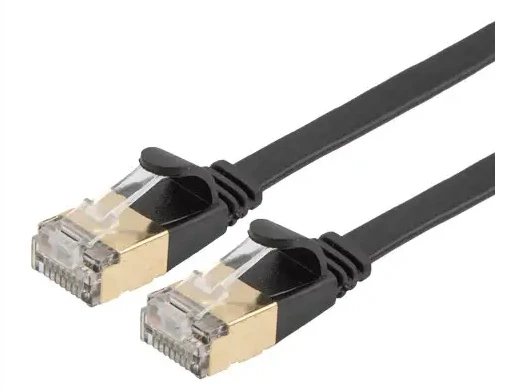
In scenarios such as gigabit network supplementation in homes, open installation at office workstations, and temporary networking at exhibitions, flat network cables have become a popular choice for concealed wiring due to their slim and compact design. This article will delve into this unique type of network cable.
1. Advantages of flat network cables
The core advantage of flat network cables is their ability to meet the demand for concealed wiring. Conventional products are only 1-2 millimeters thick, making them easy to pass through door seams, window seams, and wall gaps. They can be laid along skirting boards, door frame edges, or under carpets without the need for slotting or drilling. When fixed with transparent invisible cable clips, they have minimal visual presence and do not detract from the overall aesthetic of the original decoration, making them ideal for retrofitting network cables in well-decorated homes and finished office spaces.
II. Characteristics of flat network cables
Currently, mainstream flat network cables cover two specifications: Category 5e and Category 6, which can stably support gigabit network transmission. Some Category 6 models with shielding layers can also meet the needs of short-distance 10-gigabit networking. At the same time, they have excellent flexibility, and the cable body does not twist and entwine naturally like round cables, making it easier to store and carry. When used as desktop jumpers or short-distance connections in computer rooms, the wiring is neat and tidy, making cable management more convenient. No professional tools are required for installation, and a single person can quickly complete the wiring and fixation. Compared to traditional concealed wiring, it has a shorter construction period and lower overall cost, and is also suitable for short-term networking scenarios such as exhibitions and temporary office locations.
III. Precautions for Use
The use of flat network cables requires selection based on their structural characteristics and suitable scenarios. Due to the structural limitations of parallel cores, their signal anti-crosstalk and attenuation control capabilities are weaker than those of standard round twisted-pair cables of the same specification, making them more suitable for short-distance transmission. For long-distance high-speed networking, standard round twisted-pair cables are still preferred. When routing cables, avoid areas where heavy objects are rolled over for long periods or where people step on them frequently to prevent damage to the core insulation layer or deformation of the metal core. Do not repeatedly bend the same position to avoid metal fatigue fracture of the core. Unshielded models should be kept away from strong interference sources such as high-power power cords, air conditioning units, and power adapters. If used in areas with complex electromagnetic environments, it is recommended to prefer models with an overall shielding layer. When routing multiple cables on a daily basis, it is not advisable to bundle and stack them tightly to avoid poor heat dissipation that accelerates aging. In humid and dusty environments, it is also important to perform moisture and dust prevention on the ports and cable bodies.