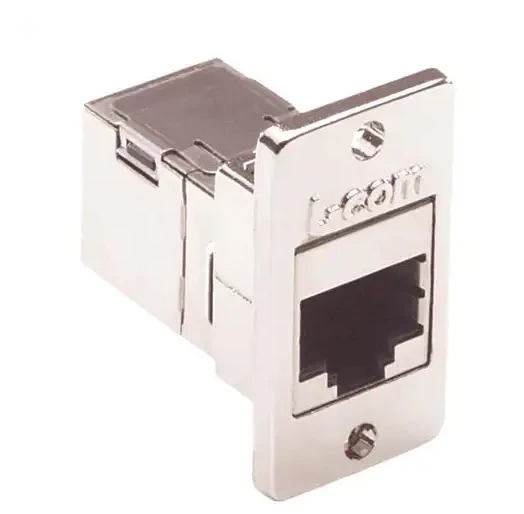
In the deployment of data centers and network equipment, the impact of connector shielding on overall performance is often overlooked. While cables often receive significant attention, connectors are equally crucial for ensuring end-to-end signal integrity, especially in high-speed, high-density application environments. Even minor signal interference can be continuously amplified.
For system integrators, subtle anomalies at the connector interface can trigger various latent faults, such as intermittent connections, signal leakage, and increased insertion loss. These issues are often difficult to locate during the troubleshooting phase. Once the shielding continuity at the connector is compromised, the shielding effectiveness of the entire cable assembly is significantly diminished. Therefore, to ensure stable equipment operation, it is imperative to select connectors that have been precisely designed to maintain shielding integrity, achieve robust mechanical connections, and maintain stable performance in various deployment scenarios.
1. Why connectors are crucial for signal integrity
The connector serves as a crucial interface between cables and network devices. Any defect in this part will directly impact the overall performance. Even minor flaws can cause signal attenuation, leading to data distortion during transmission. Poor shielding or improper interface mating can also trigger electromagnetic interference leakage, exposing signals to external noise, thereby reducing transmission quality.
In addition, increased insertion loss at connectors can weaken signal strength, which is particularly prominent in high-speed networks with minimal fault tolerance. Such failures often manifest as intermittent connections, which are not only difficult to troubleshoot but also undermine network stability. In high-performance application scenarios, these seemingly minor connector issues can quickly escalate into serious reliability hazards, reducing system operational efficiency and significantly increasing the workload of system integrators in troubleshooting.
II. The role of shielding structure in connectors
Connectors with shielding function can ensure the complete connection of the cable shielding layer at the interface. If the shielding continuity is interrupted, even the best-performing cable will have its protective effect greatly reduced.
The main functions of shielding are as follows:
Block external electromagnetic interference and radio frequency interference;
Prevent signal leakage;
Stabilize the quality of data transmission.
In an environment with dense deployment of multiple devices, the importance of shielding design becomes particularly prominent.
III. Preferred connector solution for stability performance
L-com's high-quality connectors are professionally designed to maintain continuous shielding effectiveness and stable operational performance in various application scenarios.
The main advantages are as follows:
Excellent shielding continuity;
The structure is sturdy and durable, with a long service life;
The electrical and mechanical connections are stable and reliable.
IV. Future-oriented network performance planning
As networks continue to evolve towards higher speeds and higher densities, the performance of connectors becomes increasingly crucial. Choosing high-quality shielded connectors now ensures that network infrastructure can easily meet future usage demands.
Connector shielding is crucial for maintaining network performance and operational stability. If system integrators neglect the quality of connectors, it is highly likely to cause latent failures, which in turn will affect the entire system.
Selecting reliable connectors with good shielding performance and stable operation can reduce the time spent on troubleshooting, avoid high costs due to delays, and ensure smooth project deployment.
V. Frequently Asked Questions
Q1: What is the connector shielding in the system?
Connector shielding refers to the protective structure inside the connector, which is used to prevent electromagnetic interference from entering or leaking at the interface, ensuring signal integrity between cables and network devices.
Q2: Why is connector shielding crucial to device performance?
Connectors are the weakest link in the network, making shielding design particularly crucial. Poor shielding can lead to signal attenuation, electromagnetic interference leakage, and unstable connections, which in turn can comprehensively affect the overall performance of the network.
Q3: How does a poorly shielded connector affect signal integrity?
Inadequate shielding can lead to interference from external clutter, causing issues such as signal distortion, increased bit error rate, and data retransmission. Over time, this can gradually reduce the efficiency and stability of network operations.