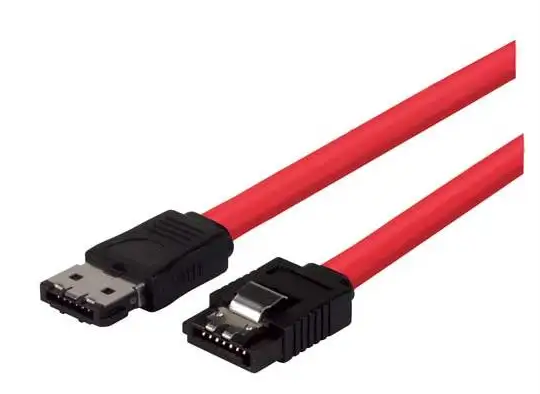
一, Understand SATA standards
1. SATA version
SATA I (1.5 Gbps)
SATA II (3.0 Gbps)
SATA III (6.0 Gbps)
SATA IV (8.0 Gbps)
Ensure that the SATA cable you choose matches the SATA version supported by your hard drive and motherboard. For example, if both your hard drive and motherboard support SATA III, you should choose a SATA III cable to fully utilize its speed advantage.
二, Cable length
Select the appropriate cable length based on the internal layout of the chassis and device location. Long cables may cause signal attenuation and interference, while short cables may not meet wiring requirements.
三, Cable type
1. Right angle connector
Advantages: Suitable for chassis with limited space, it can reduce cable bending and improve heat dissipation.
Application scenario: Suitable for small chassis or situations that require space saving.
2. Straight connector
Advantages: Strong universality, suitable for most situations.
Application scenario: Suitable for standard chassis and conventional cabling.
3. Hybrid connector
Features: One end is a right angle connector, and the other end is a straight connector.
Application scenario: Suitable for situations that require flexible wiring, which can save space and facilitate connection.
四, Shielding performance
1. Shielding layer
Unshielded: Suitable for low interference environments with low cost.
Semi shielded: It has a certain anti-interference ability and is suitable for general use environments.
Full shielding: It has strong anti-interference ability and is suitable for high interference environments, such as data centers or industrial environments.
2. Shielding material
Aluminum foil: lightweight and cost-effective, but the shielding effect is average.
Metal woven mesh: good shielding effect, but high cost.
3. Insulation material
PVC (polyvinyl chloride): Low cost, but poor heat resistance.
TPE (thermoplastic elastomer): Good flexibility and heat resistance.
TPU (thermoplastic polyurethane): wear-resistant, oil resistant, aging resistant, suitable for harsh environments.
五, Cable certification
RoHS certification: meets environmental requirements and does not contain harmful substances such as lead and mercury.
CE certification: Complies with European safety standards.
FCC certification: Complies with the standards of the Federal Communications Commission in the United States.