


To meet the requirements of data - intensive systems, the industry's demand for high - speed optical transceivers and miniaturized connection solutions will increase significantly.
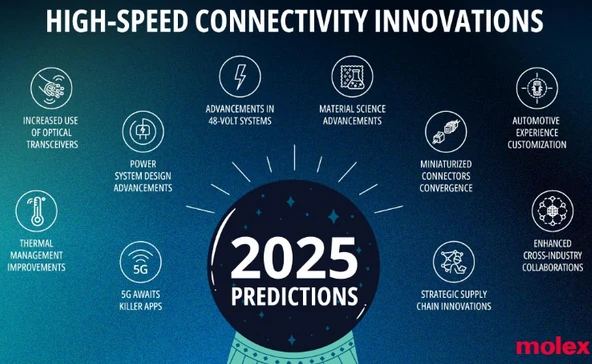
Technological breakthroughs in the fields of thermal management and power management will drive the industry to increase investment and innovation in next - generation technologies and emerging industry standards.
More flexible cross - industry collaboration and supply will enhance design flexibility and adaptive decision - making.
Molex, a global leader in the electronics industry and a pioneer in connection technology innovation, predicts that in the next 12 to 18 months, as generative artificial intelligence (AI), machine learning (ML), and cloud solutions have a greater impact on fields such as data centers, automobiles, consumer electronics, and medical technology, the market demand for reliable, durable, and high - speed connectors will increase significantly. At the same time, in order to meet the growing demand for innovation, including the urgent needs in important fields such as thermal management, power management, materials science, and battery technology, it has become very important to strengthen the collaboration among electronics product designers, manufacturing engineers, and supply chain experts.
Mike Deppe, Vice President of Global Product Development at Molex, said, "It is expected that by 2025, there will be a continuous increase in connector - related solutions to support the development of hyperscale data centers and software - defined vehicles, while breaking through the bottlenecks of miniaturization and high - performance connections in consumer and medical technology devices. As the market demand for data and instant information access continues to rise, the field of connection technology will face more opportunities and challenges. We are ready to address these challenges on behalf of our global customers, suppliers, and technology partners."
Top 10 Predictions for 2025.
1. Hyperscale data centers continue to use high - speed optical transceivers
With the rapid popularization of generative AI, operators urgently need to improve the data processing capabilities and expand the capacity of hyperscale data centers. They are accelerating the deployment of high - speed optical transceivers to achieve efficient connections both inside and outside the rack, thereby increasing port density, enhancing signal integrity, and reducing power consumption.
2. As the number of 224 Gbps PAM - 4 connectors increases sharply, thermal management technology needs to be improved urgently
With the increasing deployment of 224Gbps PAM - 4 connectors and the industry's move towards 448 Gbps PAM - 4 technology, air - cooled data center solutions have clearly reached their operational limits. This reality is driving the development of new thermal management solutions, including liquid cooling technologies such as direct chip cooling and immersion cooling. Molex is working closely with customers, power ecosystem partners, and organizations such as OCP to accelerate the development of next - generation cooling technologies and standards.
3. The development momentum of 48 - volt power systems promotes the progress of automotive functions
By increasing the system voltage four - fold, 48 - volt technology can enhance the temperature pre - regulation functions of electric turbocharging, regenerative braking, entertainment systems, and auxiliary battery charging. In addition, higher current and voltage are crucial for improving the power efficiency of sensors, actuators, and control units in advanced driver - assistance systems (ADAS).
4. The challenges of power systems remain one of the most difficult challenges in product design engineering.
The need to balance power capacity, functional safety, efficiency, cost, and performance monitoring is driving the industry's investment and innovation in battery technology and solutions to reduce signal and power interference.
5. The deployment of 5G networks is slow and will continue to be hindered as consumers expect the emergence of "killer applications"
The launch of Meta's Orion product indicates the future trend of AR glasses, but its promoting effect on 5G development still needs time to show. With the emergence of "killer applications", the industry's increased demand for high - speed wireless connections and compact micro - connectors (such as the millions of micro - connectors provided by Molex to top mobile device manufacturers) will accelerate the pace of 5G deployment.
6. The integration of connector ruggedization and miniaturization will promote cross - industry innovation
The integration of connector ruggedization and miniaturization will drive cross - industry innovation. The industry is adopting compact and durable connectors with a terminal pitch of 2.54 mm or less. This trend will dominate in electric vehicles and zonal architectures and make significant progress in fields such as consumer electronics, medical devices, industrial automation, and smart agriculture. Combining the advantages of miniaturization and ruggedization can improve space utilization, signal integrity, and thermal management performance.
7. Advances in materials science will balance product strength, weight, and environmental performance
Digital twins, artificial intelligence, and materials databases will play an increasingly important role in areas such as material property identification, processing innovation, selection, application engineering, and testing. It is expected that there will be more breakthroughs in materials science in the construction of micro - connectors, especially in balancing product strength, weight, conductivity, chemical resistance, environmental performance, and the use of bio - based materials.
8. Mass - customized manufacturing and consumer - centric automotive experiences vary by market
The development of vehicle architectures will be adjusted according to driving preferences and experiences around the world. In the dynamic Chinese market, continuous experimentation will drive innovation; while the European market, represented by German automakers, tends to adopt a variety of technologies. American automakers will focus on software - driven architectures, especially in the fields of passenger cars and sports utility vehicles.
9. Cross - industry cooperation will thrive as design engineers draw on experiences from different fields
As design engineers apply their expertise in hyperscale data centers to solve problems such as power and thermal management, sensor fusion, and signal integrity in automobiles and consumer electronics, cross - industry cooperation is expected to accelerate.
10. To cope with continuous supply chain fluctuations, inventory re - balancing and flexible supply are needed
Transform intelligence and data into practical resources to obtain real - time insights in a more rapid and accurate manner, thereby improving forecasting and risk management capabilities. This will drive the transformation of supply chain planning towards a prediction - and scenario - based model and promote a more rapid and adaptable decision - making process.


